A tungsten carbide nozzle is used to direct, accelerate, and control the flow of abrasive media, drilling fluid, slurry, air, gas, or liquid in harsh industrial environments. Its main purpose is to resist wear when material passes through the nozzle at high speed or under pressure.
Compared with ordinary steel, tungsten carbide has much higher hardness and abrasion resistance. This makes Carbide nozzles suitable for sandblasting, shot blasting, drilling tools, spray systems, descaling equipment, mining operations, oil and gas tools, and other applications where softer materials would wear too quickly.
Why Tungsten Carbide Is Used for Nozzles
A nozzle often looks like a small component, but it controls flow quality, pressure behavior, spray shape, and service life. In abrasive environments, the internal bore of the nozzle is constantly attacked by fast-moving particles. If the bore wears larger or becomes uneven, performance changes.
Tungsten carbide is used because it combines high hardness, compressive strength, thermal stability, and resistance to abrasive wear. In many industrial systems, this can mean longer operating life, fewer replacements, more stable flow, and reduced downtime.
The material is especially valuable where replacement is difficult, operating conditions are severe, or process consistency matters.
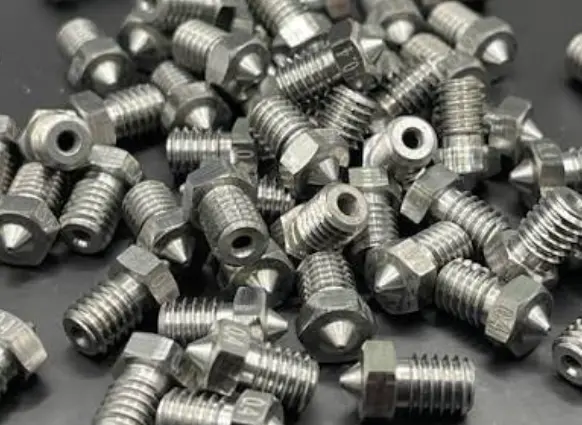
Common Uses of Tungsten Carbide Nozzles
Tungsten carbide nozzles are used in many industries. The exact design depends on the media, pressure, flow rate, temperature, and equipment connection.
Common applications include:
- Abrasive blasting
- Sandblasting cabinets
- Shot blasting systems
- High-pressure cleaning
- Oil and gas drilling tools
- Mining and tunneling equipment
- Slurry handling
- Spray drying
- Descaling systems
- Wire drawing and coating processes
- Powder spraying
- Industrial flow control
In abrasive blasting, the nozzle controls the velocity and direction of abrasive particles. In drilling tools, it helps direct fluid flow for cooling, cleaning, and hydraulic performance. In spray systems, it can help maintain a stable spray pattern under demanding conditions.
Carbide Nozzles in Abrasive Blasting
Abrasive blasting is one of the most common applications for carbide nozzles. The nozzle must withstand continuous impact from sand, steel grit, aluminum oxide, glass bead, or other blasting media.
As the internal diameter wears, blasting efficiency can drop. Air consumption may increase, the spray pattern may become inconsistent, and surface preparation quality may suffer.
A high-quality carbide nozzle design can help maintain bore size for longer periods, improving blasting consistency and reducing replacement frequency. For contractors, this can lower operating cost even if the initial nozzle price is higher than a basic steel nozzle.
Carbide Nozzles in Drilling and Mining
In drilling, mining, and tunneling equipment, nozzles may handle drilling mud, water, slurry, air, and abrasive particles. They are often exposed to pressure, vibration, impact, and erosion.
Tungsten carbide nozzles are used in drill bits, downhole tools, water jet equipment, and mining machinery because they can withstand severe wear. Stable nozzle geometry helps maintain fluid velocity and cleaning performance around the cutting area.
For drilling-related applications, buyers should pay close attention to bore size, thread type, outer shape, pressure rating, and compatibility with the tool body.
Key Design Factors
A tungsten carbide nozzle must be selected by function, not only by material. Important design factors include bore diameter, length, inlet shape, outlet shape, flow path, external dimensions, connection style, and tolerance.
The bore profile affects flow efficiency. A straight bore may be simple and durable. A venturi-style nozzle may improve acceleration and blasting performance. Custom nozzles may be designed for specific spray angles, flow rates, or equipment layouts.
Material grade also matters. Tungsten carbide is made by combining carbide particles with a binder, often cobalt or nickel. Different grades offer different balances of hardness, toughness, corrosion resistance, and impact resistance.
What Buyers Should Check Before Ordering
Before purchasing tungsten carbide nozzles, buyers should confirm the working media, pressure, temperature, flow rate, abrasive type, equipment model, connection method, and expected service life.
Important specifications include:
- Carbide grade
- Bore diameter
- Nozzle length
- Inlet and outlet geometry
- Thread or mounting style
- Dimensional tolerance
- Surface finish
- Pressure compatibility
- Wear resistance requirement
- Impact resistance requirement
- Quantity and packaging
For OEM projects, drawings or samples are often needed. Small dimensional differences can affect fit, flow, and performance.
Tungsten Carbide vs. Other Nozzle Materials
Nozzles can be made from steel, stainless steel, ceramic, boron carbide, silicon carbide, and tungsten carbide. Each material has strengths.
Steel is low cost but wears quickly in abrasive conditions. Ceramic offers good wear resistance but may be more brittle. Boron carbide can provide excellent wear resistance in blasting, but it may cost more. Tungsten carbide offers a practical balance of wear resistance, toughness, and cost for many industrial applications.
This is why Carbide nozzles are widely used where both abrasion resistance and mechanical durability are required.
Maintenance and Replacement
Even tungsten carbide nozzles eventually wear. Regular inspection helps maintain process quality. Operators should check bore diameter, outlet shape, cracks, chips, uneven wear, and connection damage.
In blasting systems, an enlarged bore can increase air demand and reduce performance. In drilling systems, nozzle wear can change fluid flow and reduce cleaning efficiency. Replacing the nozzle at the right time helps protect both equipment performance and operating cost.
Final Thoughts
A tungsten carbide nozzle is used to control and direct abrasive or high-pressure flow in demanding industrial environments. Its main advantage is wear resistance, making it suitable for blasting, spraying, drilling, mining, slurry handling, and flow-control applications.
When choosing Carbide nozzles, buyers should evaluate the working media, pressure, flow rate, bore design, carbide grade, connection method, and equipment compatibility. The right nozzle can improve service life, reduce downtime, and maintain stable process performance.
For tungsten carbide nozzle and drilling tool product information, visit Drillstar Global.