A 2 axis lathe is a turning machine that controls the cutting tool along two linear axes, typically called the X-axis and Z-axis. It is one of the most common CNC turning configurations because it can machine a wide range of round, cylindrical, tapered, threaded, and faced components with efficient programming and reliable repeatability.
In a standard CNC lathe arrangement, the workpiece rotates in the spindle while the cutting tool moves in relation to it. The two controlled axes allow the tool to move across the workpiece diameter and along its length, creating the part profile.
A 2 axis lathe is often the right choice for parts that are primarily rotationally symmetrical. It is less complex than a multi-axis turning center, but it remains highly capable for many production and repair applications.
What Are the Two Axes on a Lathe?
The two axes on a conventional CNC turning machine are usually:
- X-axis: Moves the tool toward or away from the workpiece centerline. This movement controls the diameter being machined.
- Z-axis: Moves the tool parallel to the spindle centerline. This movement controls the lengthwise position of the cut.
CNC lathe coordinate references commonly identify X and Z as the standard two turning axes. The Support for CNC turning guide describes the normal two-axis cutting path as X and Z.
In many CNC programs, X dimensions are expressed as diameters rather than radii. This convention makes it easier for machinists to program turning operations directly from part drawings.
How Does a 2 Axis CNC Lathe Work?
The workpiece is clamped in a chuck, collet, fixture, or other workholding device and rotates at a programmed spindle speed. A tool mounted in a turret, tool post, or ram moves in the X and Z directions according to the CNC program.
The machine coordinates the two axes to produce a defined profile. For example, the tool can move in X while moving in Z to machine a taper or curved contour.
Typical operations include:
- Facing
- External diameter turning
- Internal boring
- Taper turning
- Profiling
- Grooving
- Parting off
- Threading
- Drilling along the centerline
- Reaming and tapping with suitable tooling
The simplicity of X-Z motion makes the 2 axis lathe efficient for shafts, bushings, rings, flanges, hubs, sleeves, and other rotational parts.
What Can a 2 Axis Lathe Not Do?
A 2 axis lathe is designed mainly for axisymmetric turning work. It does not normally perform complex off-center milling, cross-drilling, angled holes, keyways, or polygonal features without additional equipment.
These operations often require extra machine functions, such as:
- C-axis spindle positioning
- Y-axis tool movement
- Live tooling
- Sub-spindles
- Milling spindles
- Multi-turret configurations
A 3-axis or multi-axis turning center can provide more flexibility, but it may also require a larger investment, more complex programming, and additional setup time.
2 Axis Lathe vs. Multi-Axis Turning Center
| Feature |
2 Axis Lathe |
Multi-Axis Turning Center |
| Primary controlled axes |
X and Z |
X, Z, plus C, Y, or other axes |
| Best for |
Rotationally symmetric parts |
Complex turned and milled parts |
| Programming complexity |
Lower |
Higher |
| Setup requirements |
Usually simpler |
Often more involved |
| Investment level |
Generally lower |
Generally higher |
| Common operations |
Turning, boring, facing, threading |
Turning plus milling, drilling, and complex features |
The best choice depends on the part family, production quantity, tolerance requirements, and whether secondary machining operations are acceptable.
Is a Double Column Vertical Lathe a 2 Axis Lathe?
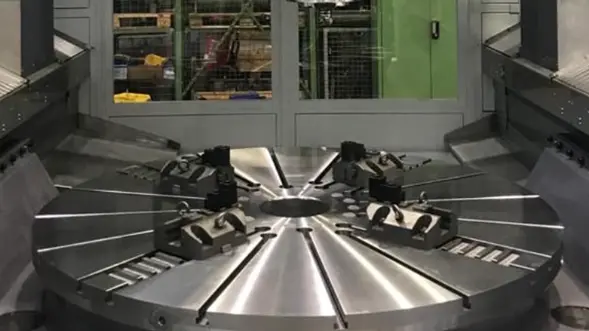
A Double Column Vertical Lathe can be configured as a 2-axis CNC machine, but “double column” and “2-axis” describe different aspects of the machine.
- Double column describes the machine structure. Two vertical columns support a crossrail, creating a rigid frame for large and heavy workpieces.
- 2-axis describes the number of CNC-controlled tool movements.
In a vertical turning configuration, the workpiece sits on a horizontal rotating table. The tool ram generally moves vertically and radially to machine the part. This arrangement is especially useful for large-diameter, heavy, or difficult-to-handle components because gravity helps keep the workpiece stable on the table.
A Double Column Vertical Lathe may use two controlled axes for conventional turning operations, or it may include additional CNC axes, multiple rams, live tooling, or milling functions. Buyers should always review the machine’s exact axis configuration rather than assuming capability from the machine name alone.
Typical Applications of 2 Axis Lathes
2 axis CNC lathes are used across many industries, including:
- Automotive components
- Hydraulic cylinders and fittings
- Oil and gas parts
- Pump and valve components
- Railway and transportation parts
- Aerospace rotational components
- General machinery parts
- Tooling and maintenance work
- Flanges, rings, and large-diameter components
For heavy-duty work, a Double Column Vertical Lathe is often selected for large gears, turbine components, bearing rings, pressure-vessel parts, wheel hubs, and similar workpieces that may be difficult to hold safely on a horizontal machine.
Advantages of a 2 Axis Lathe
A 2 axis lathe offers several practical benefits:
Simple Programming
X-Z turning programs are generally easier to create, verify, and optimize than multi-axis machining programs.
Efficient Cycle Times
For parts requiring only turning operations, a 2 axis lathe can complete the work quickly without unnecessary machine complexity.
Good Repeatability
CNC control, rigid workholding, and consistent tool offsets help produce repeatable dimensions in batch production.
Lower Cost of Ownership
Compared with more complex turning centers, a 2 axis machine may have a lower purchase price, lower maintenance burden, and simpler operator training requirements.
Strong Fit for Rotational Parts
For cylindrical components, a properly selected 2 axis machine can provide an excellent balance of productivity, accuracy, and cost.
What to Consider Before Buying
When selecting a 2 axis lathe or a Double Column Vertical Lathe, evaluate:
- Maximum turning diameter and length
- Workpiece weight capacity
- Chuck or table size
- Spindle power and torque
- X-axis and Z-axis travel
- Required accuracy and repeatability
- Tool capacity and turret type
- Material type and chip-control needs
- Automation requirements
- Available floor space and lifting capacity
- Need for future milling, drilling, or multi-axis work
A machine that is ideal for short shafts may not be appropriate for large rings or heavy industrial components. Matching the machine to the part size and process requirements is essential.
Final Thoughts
A 2 axis lathe is a CNC turning machine that uses X-axis and Z-axis motion to machine rotational parts. It is a practical, productive choice for facing, turning, boring, grooving, profiling, and threading operations.
A Double Column Vertical Lathe may also operate as a 2-axis turning machine, particularly for large and heavy workpieces. However, the double-column structure does not automatically define the number of CNC axes. Always confirm the machine’s actual configuration, capacity, and optional functions before selecting equipment.