A horizontal lathe is one of the most widely used machine tools in metalworking. It rotates a workpiece around a horizontal spindle axis while a cutting tool removes material to create precise diameters, faces, threads, grooves, tapers, and other features.
From repair workshops to heavy-equipment factories, horizontal lathes remain essential for machining shafts, sleeves, flanges, rollers, bushings, pipes, and other cylindrical parts. Their versatility, rigidity, and straightforward operating principle make them a practical choice for both small-batch work and large industrial components.
A horizontal lathe holds the workpiece in a chuck, collet, faceplate, or between centers. The spindle rotates the workpiece, while the cutting tool is mounted on a toolpost attached to the carriage.
The operator or CNC control moves the tool along two main directions:
- Longitudinal movement: The tool travels parallel to the workpiece axis for straight turning and threading.
- Cross movement: The tool travels toward or away from the workpiece centerline for facing, diameter reduction, and grooving.
By controlling spindle speed, feed rate, depth of cut, and tool geometry, the machine can produce accurate surfaces and dimensions.
Main Components of a Horizontal Lathe
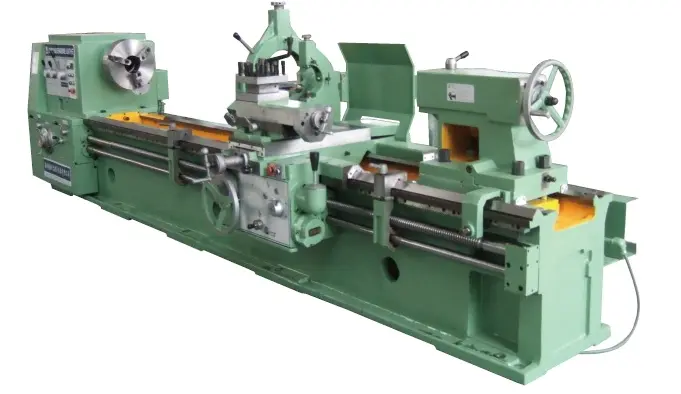
Although configurations vary by model and capacity, most horizontal lathes include the following key parts:
- Bed: The rigid base that supports and aligns major machine components.
- Headstock: Houses the spindle, drive system, speed controls, and workholding connection.
- Chuck or faceplate: Holds and rotates the workpiece.
- Carriage: Moves the cutting tool along the bed.
- Cross slide and compound rest: Provide controlled transverse and angled tool movement.
- Toolpost: Secures the cutting tool.
- Tailstock: Supports long workpieces or holds drills, reamers, and other tools.
- Lead screw and feed rod: Drive automatic feeds and threading operations.
- Chip tray and coolant system: Help manage chips and control cutting temperature.
A well-built machine combines these components to maintain accuracy under cutting loads.
What Operations Can a Horizontal Lathe Perform?
The basic function of a horizontal lathe is turning, but it can perform many machining operations when equipped with suitable tooling.
Common operations include:
- External and internal turning
- Facing
- Boring
- Drilling
- Reaming
- Thread cutting
- Taper turning
- Grooving
- Parting-off
- Knurling
This flexibility allows manufacturers to machine different features without moving the workpiece between multiple machines.
Horizontal Lathe vs. Vertical Lathe
The main difference is the direction of the spindle axis. A horizontal lathe rotates the workpiece along a horizontal axis, while a vertical lathe holds the workpiece on a vertical table.
Horizontal lathes are generally well-suited to long shafts, bars, tubes, and cylindrical components. Vertical lathes are often selected for very large, heavy, or wide-diameter workpieces because the part can rest on a rotary table rather than being supported horizontally.
The right choice depends on workpiece dimensions, weight, production volume, tolerance requirements, and available floor space.
Why Choose a CWCQW Horizontal Lathe?
A CWCQW Horizontal Lathe is typically considered for applications requiring stable cutting performance, a large swing capacity, and reliable machining of medium-to-heavy workpieces. When evaluating a machine in this category, buyers should focus on the specifications that affect their actual production needs.
Important selection factors include:
- Maximum swing over bed and cross slide
- Distance between centers
- Maximum workpiece weight
- Spindle bore diameter
- Spindle speed range
- Motor power
- Available feeds and thread ranges
- Bed width and machine rigidity
- Accuracy standards and inspection process
- Availability of steady rests, follow rests, chucks, and tooling
For heavy-duty machining, a rigid bed and adequate motor power are especially important. These features help maintain surface finish and dimensional stability when machining large or difficult materials.
Typical Applications
Horizontal lathes are used across a wide range of industries, including:
- General engineering and maintenance
- Automotive and transport equipment
- Oil and gas equipment
- Construction machinery
- Agricultural machinery
- Power-generation components
- Shipbuilding and marine equipment
- Railway and rolling-stock maintenance
- Tooling and prototype manufacturing
In these environments, the machine may be used to produce new parts, repair worn components, or machine custom workpieces to drawing specifications.
Safety and Maintenance
Like all machine tools, a horizontal lathe should be operated by trained personnel using appropriate safety procedures. Operators should secure the workpiece correctly, remove the chuck key before starting, use guards where required, and keep their hands clear of rotating parts and sharp chips.
Routine maintenance supports both safety and machining accuracy. This includes checking lubrication, cleaning chips from guideways, inspecting belts and electrical connections, verifying alignment, and maintaining the condition of cutting tools and workholding equipment.
Conclusion
A horizontal lathe is a versatile machine tool that rotates a workpiece on a horizontal axis for precision turning and related metalworking operations. Its core strengths are flexibility, stable workholding, and the ability to machine a wide range of cylindrical parts.
When selecting a CWCQW Horizontal Lathe, buyers should match the machine’s capacity, spindle performance, rigidity, and accessories to their specific materials, workpiece dimensions, and production requirements. A correctly specified horizontal lathe can provide reliable performance for years of manufacturing and repair work.